A newly drilled well is a household about to taste its water and go looking for a softener. You get every one in your 75-mile radius, hardest water first — so you know which addresses are worth the drive before you leave the shop. And it is not one sale: a house that puts in a softener buys salt from somebody for the next ten years.
Nobody else is working this list. One dealer per territory. Take one and it comes off this page. For as long as you keep it, we will not sell that territory’s feed to another water treatment business — not at a higher price, not to a franchise, not to anyone.
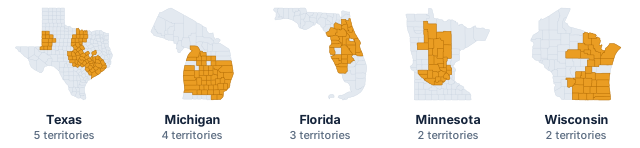
A territory sells once. There are 16 across 5 states and all of them are open today — which also means every other dealer working your area can still take yours. How the numbers are built →
See what a homeowner gets handed: the doorstep report for a real Parker County property →
What arrives with every address
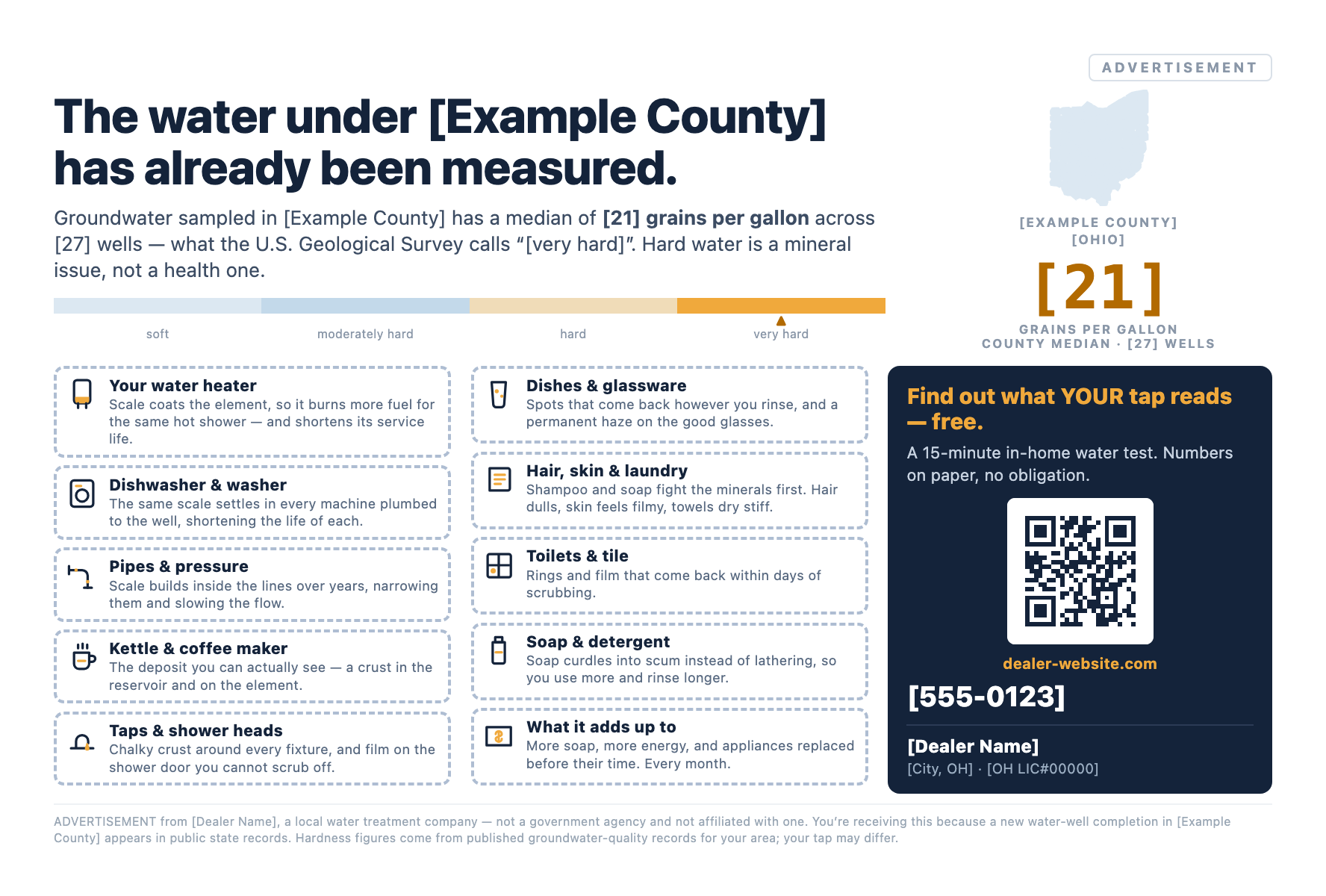
The one on the right is real. A well filed in Parker County, the groundwater measured around it, and every reading drawn against the limit it is judged by — hardness at 2.1× the industry threshold, every other reading sitting well under its limit.
A homeowner sees which bars cross the line without reading a number. The softener is already sized for the house: 24,000 grain, regenerating about every seven days, roughly nine bags of salt a year.
Two things are removed from this public copy — the street address and the direct link to that well’s filed state record. Both are on every copy a dealer receives. Territories are exclusive, so the sample gives up the field that names a household and nothing else.
Not your county? Get the same thing for the wells filed near you last week — free →
Who else gets these addresses
And you are not being priced on what someone guesses you can afford. A territory costs what it costs because of how many hard-water wells get filed in it each year — the number on every row below. Not your revenue, not which state you are in, not how the call went. Below a published floor a territory is not sold at any price. The arithmetic →
Sixteen territories across five states, one dealer each. See all sixteen, with maps and counties →
What lands on a Monday: the addresses, what the water around each one is like, a report per property you can hand over at the door, and the whole week already in the order you should drive it. Everything that arrives →
What it costs
Territories are priced by how many qualified leads they produce: $199, $399, $599, $799 or $1,199 a cycle — billed every four weeks, which is 13 payments a year rather than 12.
Every territory’s number, along with the floor below which one is not sold at all, is on the territory map.
A shared lead from a lead broker runs $20–75 — one homeowner, sold to you and your competitors, and in a rural area unbuyable in volume at all.
At a typical $1,000 gross profit, the smallest territory pays for itself on 2.6 installs a year and the largest on 15.6 — under a 1% close rate at every tier. Whatever your own close rate is, you know it better than I do. Hold it against those two numbers.
The First Install Guarantee. Work your territory for ninety days. If it hasn’t produced one installed system, you don’t pay again until it does — the list keeps coming, you keep the territory, and the billing stops until you’ve had your first install.
Nothing here promises anything about your water, your wells or your close rate. It is a promise about what I will do.
Straight about timing
In Texas, drillers have 60 days to file a completion report; other states differ. We read the state file the night it posts and send within the week — but half of all wells are filed more than a month after drilling finishes.
Nobody working from the public record can do better. What we can tell you is which of those households has a water problem — which is what decides whether the drive is worth it.
Before you put your name on it
So none of them are mine. Every figure on the sheet you hand over is a measurement a state agency published, and the report says which one and links to it — the homeowner can check you, which is exactly what you want them to be able to do. No modelling, no estimation, no AI, and every formula and threshold is at /methodology.
The sheet also says what it does not know. Where nobody has tested nearby for something, it says so by name rather than leaving a gap that reads like a clean bill of health — because the one thing that would cost you the sale is being contradicted by a lab result a week later.
No testimonials, because there are no customers yet — I’d rather say so than borrow someone else’s.
Your county, not this one
If yours is taken it is taken; if it is yours, nobody else works the same addresses off the same list.